
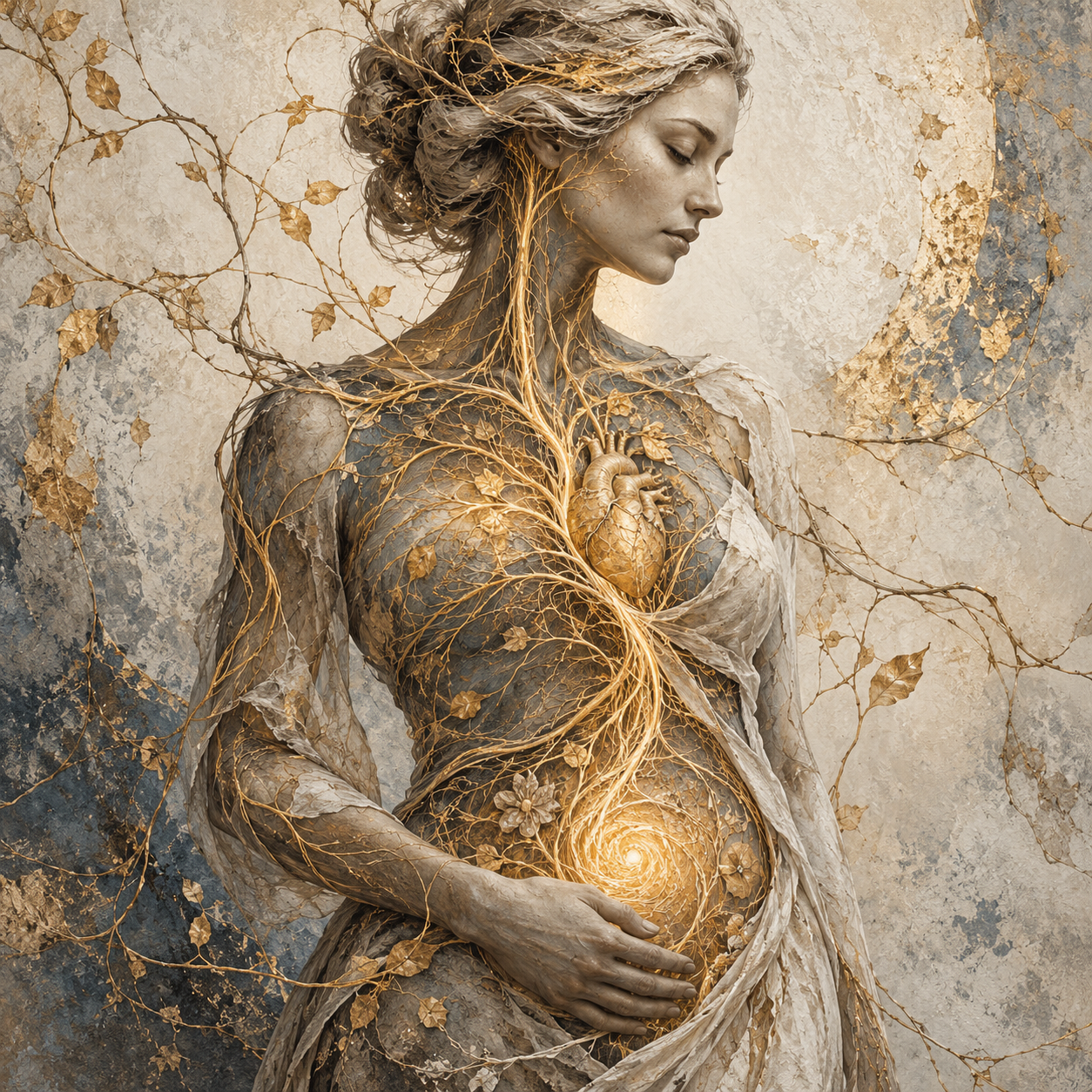
There is something beautiful about the biological continuity between generations. We see our parents in our own faces and recognise our grandparents in our children. But our connections extend beyond the characteristics we inherit.
During pregnancy, living cells cross the placenta in both directions. Some remain for decades, carrying genetically distinct DNA. This phenomenon, which is known as microchimerism, means that a mother may carry cells originating from her child long after birth, while the child may retain cells originating from the mother.
Another remarkable connection reaches across three generations. When my grandmother was pregnant with my mother, my mother's developing ovaries already contained immature egg cells. Among them was the precursor to the egg that would eventually contribute to my conception.
I find that extraordinary. We are unique individuals, yet our lives emerge from biological relationships extending far beyond ourselves. And those relationships continue to shape us throughout life.
When our bodies learn
Consider breastfeeding. As a baby feeds, the mother's body releases oxytocin and prolactin, supporting milk production.
But something fascinating can happen before feeding even begins.
A 1983 a British Medical Journal study found that oxytocin increased several minutes before suckling in all ten women studied. The responses were associated with familiar cues, including babies crying or becoming restless, and mothers preparing to feed.
Although small, the study illustrates how physiological responses can become conditioned through experience. A mother's body can start preparing to feed her baby before it begins.
Through repeated interaction, her body has learned to respond to the anticipated needs of another person.
Oxytocin also plays a central role in childbirth. Birthing partners are encouraged to provide reassurance and help the person giving birth feel safe, partly because excessive stress can interfere with the physiological processes supporting labour. Continuous companionship is associated with better birth experiences and certain improved outcomes.
The biology of attachment is not confined to mothers. Research by Ruth Feldman and colleagues found broadly similar measured oxytocin levels in first-time mothers and fathers during early parenthood, with parental interactions associated with oxytocin in both groups. Attachment also develops through responsive care within adoptive families.
These findings remind us that human relationships are not simply experiences we remember. They participate in our biological lives.
The body's quiet intelligence
Much of what happens when people are together occurs without language.
We recognise unease in a familiar expression or sense that someone needs our company. Our bodies sometimes respond before we have consciously identified what we have noticed.
Research on interpersonal synchrony has found that people's movements and physiological rhythms can sometimes become coordinated during social interaction.
Our relationships also involve complex neurobiology. Oxytocin contributes to aspects of attachment and social recognition. Dopamine participates in motivation and reward, while endogenous opioids contribute to pain regulation and social comfort. Vasopressin is implicated in social affiliation, serotonin in mood regulation, and cortisol, adrenaline and noradrenaline in our responses to stress.
None of these chemicals individually explains love or belonging. Their effects are context-dependent, and the experience of connection cannot be reduced to neurochemistry.
But think about the calm we sometimes feel among people we trust. Nothing particularly important needs to be said. We simply find ourselves relaxing.
Supportive relationships can influence physiological stress responses, while research has implicated oxytocin in cooperation and group affiliation. Such processes may contribute to belonging within teams and communities.
We do not simply understand that we belong. We can feel that we belong.
Intuition and the body that remembers
This brings us to intuition.
We've all experienced a gut feeling we struggle to explain. Neuroscience offers an interesting perspective through interoception, our nervous system's capacity to sense and interpret internal bodily signals.
Antonio Damasio's somatic marker hypothesis proposes that bodily states associated with previous experiences can influence subsequent decisions, sometimes before we consciously articulate our reasoning.
Bessel van der Kolk explores a related phenomenon in The Body Keeps the Score. Previous experiences of danger can influence physiological responses long after the original threat has passed. Someone may consciously recognise that they are safe while continuing to experience bodily alarm.
Accordingly, learned physiological responses may be considered an important aspect of how past experience influences present behaviour.
Our intuitions are not infallible. They may reflect mistaken associations or prejudice. But neither are they necessarily irrational.
They may involve the integration of bodily information, memory and experience before we can consciously explain what we have recognised.
Perhaps wisdom therefore, is not simply what we know, but how our lived experience informs what we perceive, feel and judge.
Intelligence is relational
In Ways of Being, James Bridle invites us to reconsider what we mean by intelligence.
Bridle challenges the tendency to treat intelligence as something located exclusively within an individual mind, separate from the world in which that individual exists.
Instead, he explores how intelligence emerges and is expressed through relationships between living beings and their environments.
The book draws upon remarkable examples from the natural world, including the intelligence of animals, plants and ecological systems, to challenge the assumption that human cognition provides the definitive model against which all other forms of intelligence should be measured.
One example concerns gibbons whose intelligence was underestimated when researchers assessed their abilities through tasks designed around human expectations. When the tasks were adapted to accommodate the animals' natural movements, previously unrecognised capabilities became apparent.
The problem was not necessarily the animals' intelligence, but the inadequacy of the framework through which we attempted to measure it.
I find Bridle's argument particularly interesting because it changes how we think about human intelligence too.
We do not develop our understanding independently of our relationships with the world. Our capacities emerge through our encounters with others and the environments we inhabit.
The examples of breastfeeding, attachment and intuition are not simply illustrations of biological complexity. They also show how human capacities develop through ongoing relationships.
Our intelligence is not something that exists entirely apart from our bodies and experiences.
This connects with Maurice Merleau-Ponty's philosophy of embodiment, which challenges the idea that human beings encounter the world as detached minds processing information.
It also raises an important distinction for AI.
Bridle does not argue that intelligence belongs exclusively to human beings. Quite the opposite. His work encourages us to recognise intelligence in forms of life very different from our own and to remain open to different kinds of intelligence.
But recognising that intelligence may take many forms does not establish that those forms are interchangeable.
An artificial system may display remarkable capabilities without possessing the embodied, relational or subjective characteristics of human intelligence.
Perhaps the question is not simply how intelligent a system is, but what kind of intelligence it possesses, and what exactly makes that intelligence possible.
Prediction is not experience
Thomas Nagel argued in What Is It Like to Be a Bat? that conscious experience possesses an irreducibly subjective character in that there is something it is like to be a particular conscious being.
John Searle's Chinese Room argument similarly challenged the assumption that successfully manipulating symbols necessarily constitutes understanding their meaning.
Both positions remain important to contemporary debates about artificial consciousness, although neither settles the question conclusively.
A large language model can generate extraordinarily sophisticated descriptions of human experience. It can discuss childbirth without having given birth, or produce sensitive language about bereavement without drawing upon personal memories of loss.
Its responses emerge through computational inference, shaped by training data, learned statistical relationships and conversational context.
AI predictions can be enormously useful, sometimes more accurate than human intuition. But predictive capability does not establish lived experience.
The human being speaks from somewhere. A chatbot has no established first-person, lived perspective of its own.
Yet the absence of a personal perspective does not make it neutral.
The silicon gaze
In The Silicon Gaze (2026), Francisco Kerche, Matthew Zook and Mark Graham analysed approximately 20.3 million queries to ChatGPT, identifying systematic geographic inequalities in the model's representations.
Their research exposes a fundamental problem: AI systems learn from information produced within unequal societies.
Some communities and institutions possess far greater resources to document their experiences. Their perspectives are consequently more extensively represented in the digital record.
Models trained on these uneven information environments can reproduce the assumptions and inequalities embedded within them.
Linguistic disparities provide another illustration. Research has identified English-language interference in generated Dutch and French, while other studies document performance differences across languages and the persistence of culturally dominant assumptions.
A model may speak another language fluently while retaining assumptions associated with more dominant sources in its training data. As a result, fluency does not necessarily establish cultural understanding.
An AI system need not possess personal prejudice to reproduce bias. Its outputs are shaped by the information and institutional decisions underlying its development.
The view from nowhere is not necessarily a view from everywhere.
Artificial intimacy and the absence of reciprocity
Sherry Turkle has spent decades examining how technology reshapes human relationships.
Her latest book, Artificial Intimacy, considers what happens when we accept simulated intimacy as a substitute for human connection. Her concerns become particularly significant alongside Searle and Nagel.
A chatbot may produce language suggesting understanding and affection without possessing the corresponding subjective experience.
The person interacting with it, however, may experience genuine attachment.
Their feelings may become deeply consequential. They may depend upon the interaction for reassurance or experience distress if it ends.
The human being has skin in the game but the chatbot does not. This asymmetry is easily obscured by increasingly convincing conversational responses.
Human relationships involve another person with an independent life. Their concern has significance because they can genuinely care, make sacrifices and bear consequences.
There is also an institutional asymmetry. Although the chatbot may have no personal interest in sustaining the relationship, the company operating it may benefit commercially from prolonged engagement.
Artificial intimacy is therefore a question of power and accountability as well as philosophy.
A system may produce reassuring, personalised language while operating within an infrastructure shaped by commercial incentives and structurally uneven training data.
The user may experience genuine intimacy without knowing much about the forces shaping the responses they receive.
This deserves serious scrutiny.
Protecting the conditions of human flourishing
These distinctions are especially consequential for children.
Social development begins before language, through embodied interactions with caregivers. As children grow, relationships with peers help them recognise other people's independent needs and navigate disagreement.
AI may offer educational and accessibility benefits, but artificial companionship should not be presumed developmentally equivalent to human relationships. The long-term consequences of sustained emotional attachment to chatbots remain insufficiently understood.
There is also a broader question of autonomy.
John Stuart Mill understood human flourishing as involving the active development of our faculties. We develop judgement through experience, reflection and encounters with perspectives different from our own.
A system may satisfy our immediate preferences without strengthening our capacity to examine them.
We should not confuse convenience with autonomy.
A human-rights-based approach to AI must therefore consider more than the prevention of identifiable harms. It must also protect the conditions necessary for independent thought, meaningful relationships and human flourishing.
Embodied Wisdom
I keep returning to those extraordinary biological connections between generations, and to the mother's body that learns to anticipate feeding her baby.
They remind us that our experiences are not confined to conscious thought. Our bodies develop responses shaped by the people around us.
We recognise familiar expressions and sometimes sense distress before anything is said. Our experiences of safety and danger influence how we encounter the world.
As James Bridle reminds us, intelligence itself cannot always be understood independently of the relationships and environments through which it emerges.
Through these experiences, we develop the understanding and judgement that help shape who we become because there is something it is like to be you. Your understanding emerges from a particular life, lived through a particular body.
AI may reproduce aspects of your language and generate sophisticated accounts of your experiences. But it does not thereby become you, or another human being sharing a reciprocal relationship with you and it certainly can never replicate or replace you.
Its responses are shaped by information that is neither neutral nor equally representative of the world. Its apparent understanding does not establish subjective experience, and its expressions of care do not arise from genuine concern.
None of this requires rejecting artificial intelligence or denying that intelligence may exist in forms radically different from our own. Indeed, Bridle's work encourages us to broaden our understanding of intelligence rather than confining it to humanity.
But recognising different forms of intelligence should not lead us to assume that they are interchangeable, or that reproducing a human capability means reproducing the human experience from which it emerges.
It should, however, make us pause and consider whether such systems should ever be granted equivalent legal or moral standing.
I would argue not, certainly not on the basis of intelligence or computational capability alone.
Legal personhood and moral status raise different questions, but neither should follow automatically from a machine's ability to reproduce human behaviour.
Our conception of human dignity rests upon something more profound than our intellectual capabilities. It recognises the inherent worth of beings whose lives are experienced from within by virtue of the fact that they have been born and whose existence is marked by vulnerability and whose relationships carry consequences for themselves and others.
The possibility of increasingly sophisticated artificial intelligence should encourage us to examine more carefully the foundations of human rights, rather than assume that those rights ought to extend to machines simply because they can imitate some of our capacities.
