CDE Publications

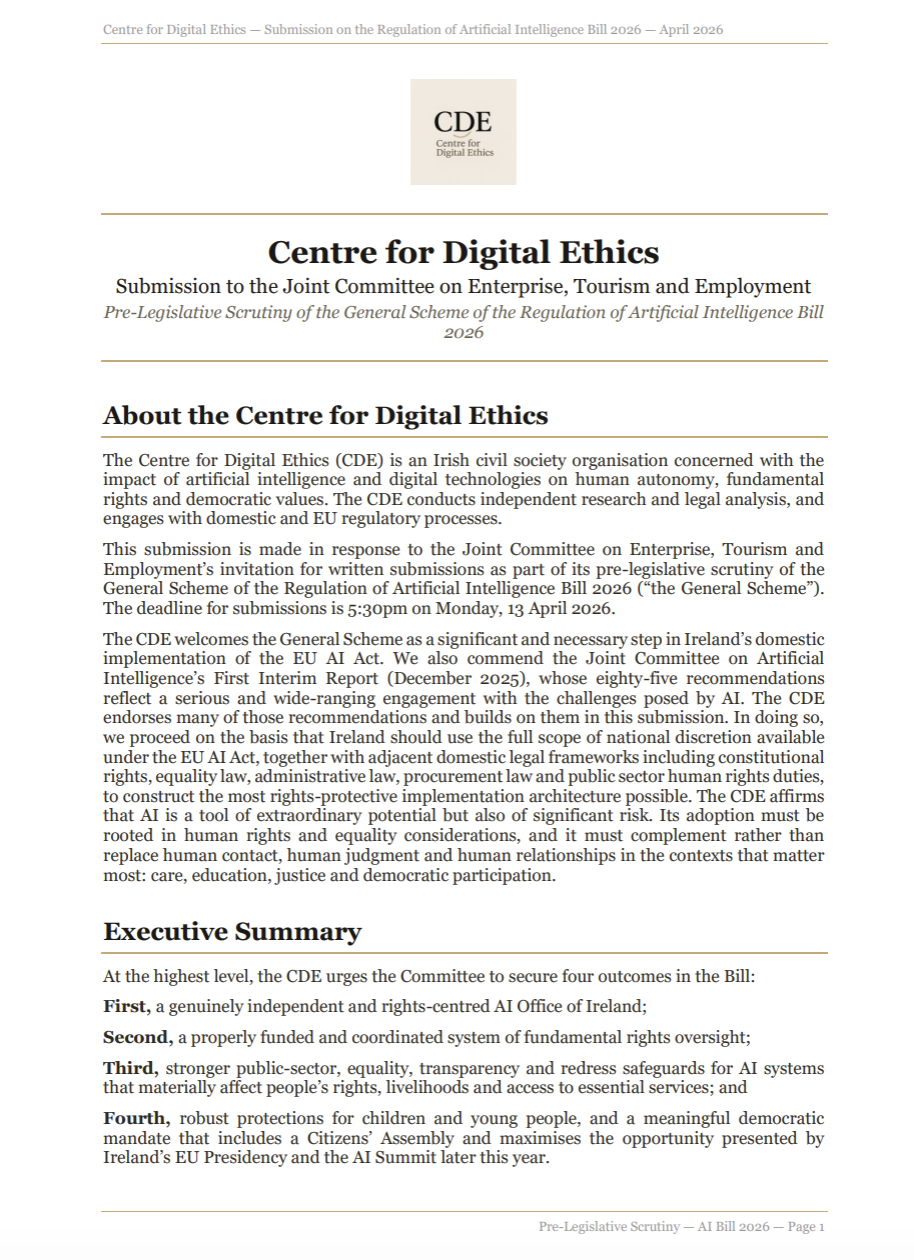
CDE AI Bill 2026 Submission
This submission outlines the CDE’s recommendations for Ireland’s proposed Regulation of Artificial Intelligence Bill 2026. It calls for a strong, rights-based approach to AI governance, emphasising independent oversight, protection of fundamental rights, transparency, and safeguards for vulnerable groups, particularly children. The document also highlights the need for accountability, public engagement, and robust regulation of AI systems that impact people’s lives, livelihoods, and democratic processes.

Read the full submission →

Submission made to the Joint Committee on Enterprise, Tourism and Employment

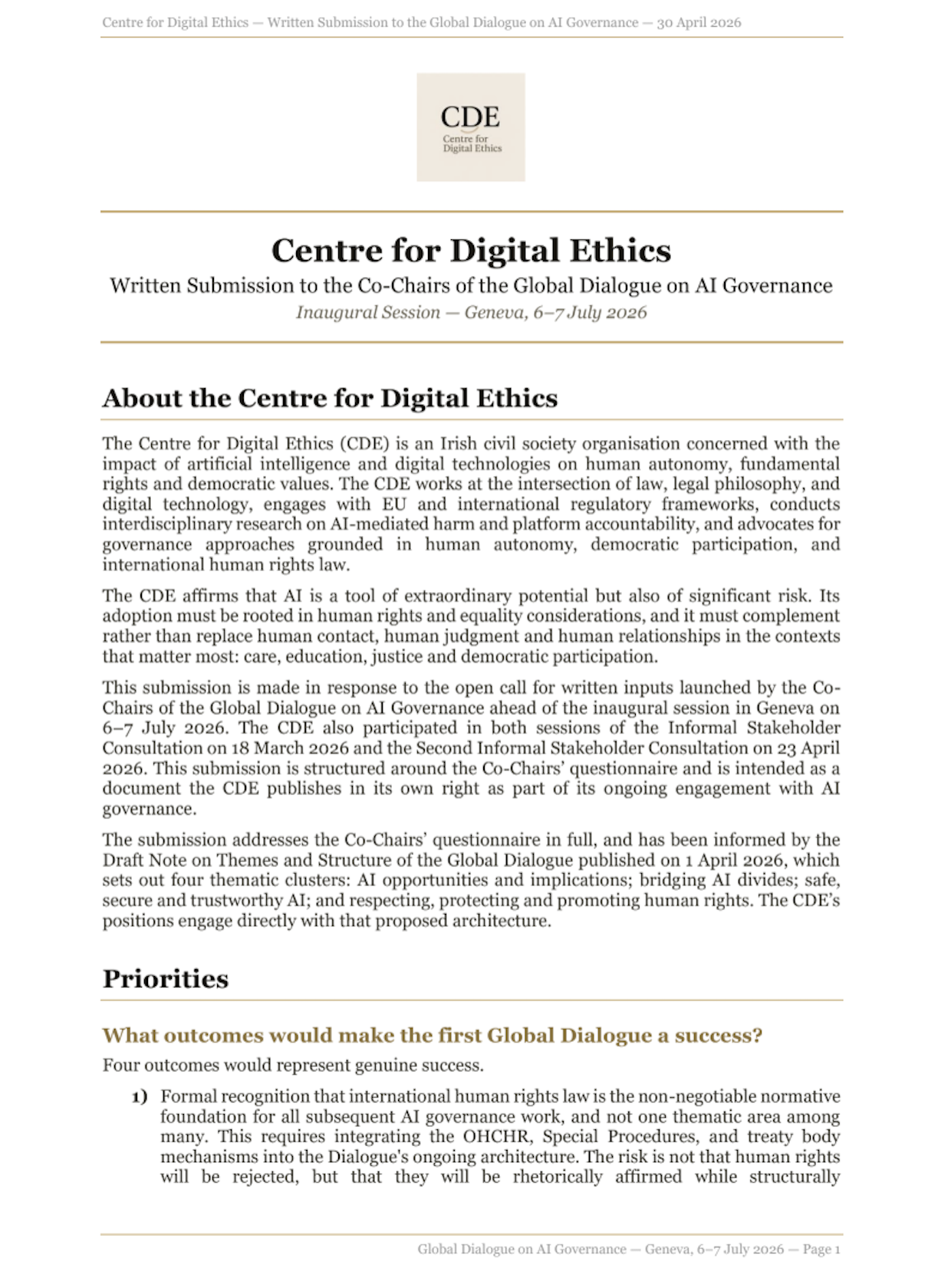
CDE UN Global Dialogue on AI Governance 2026 Submission

Submission made to the Co- Chairs of the Global Dialogue on AI Governance 

This publication highlights the CDE’s formal submission to the inaugural UN Global Dialogue on AI Governance in Geneva. The CDE argues that international human rights law must form the foundation of global AI governance and calls for stronger accountability mechanisms to address structural harms, democratic risks, corporate power concentration, frontier AI systems, and cross-border enforcement gaps. It proposes a rights-grounded “governance floor” for AI regulation, advocates for inclusive multistakeholder participation, and outlines concrete recommendations for international cooperation, AI oversight, and institutional reform.

Read the full submission

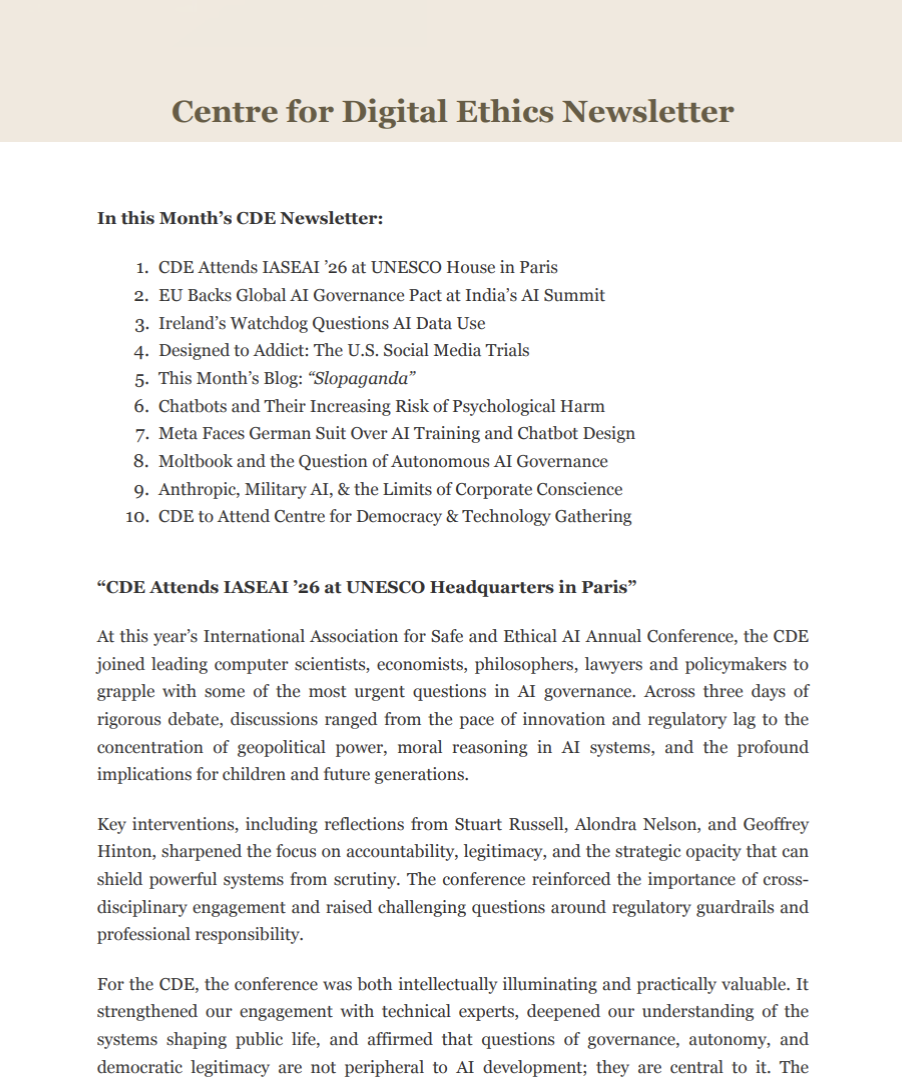
CDE March Newsletter

This edition of the CDE newsletter provides an overview of key global developments in artificial intelligence, digital regulation, and online safety. It covers major policy debates, legal cases, and emerging risks, from AI governance and data protection to social media design, children’s safety, and the psychological impacts of chatbots, alongside insights from the CDE’s research, events, and latest blog content.

Read the full newsletter →

Monthly Newsletter sent directly subscribers inboxes 

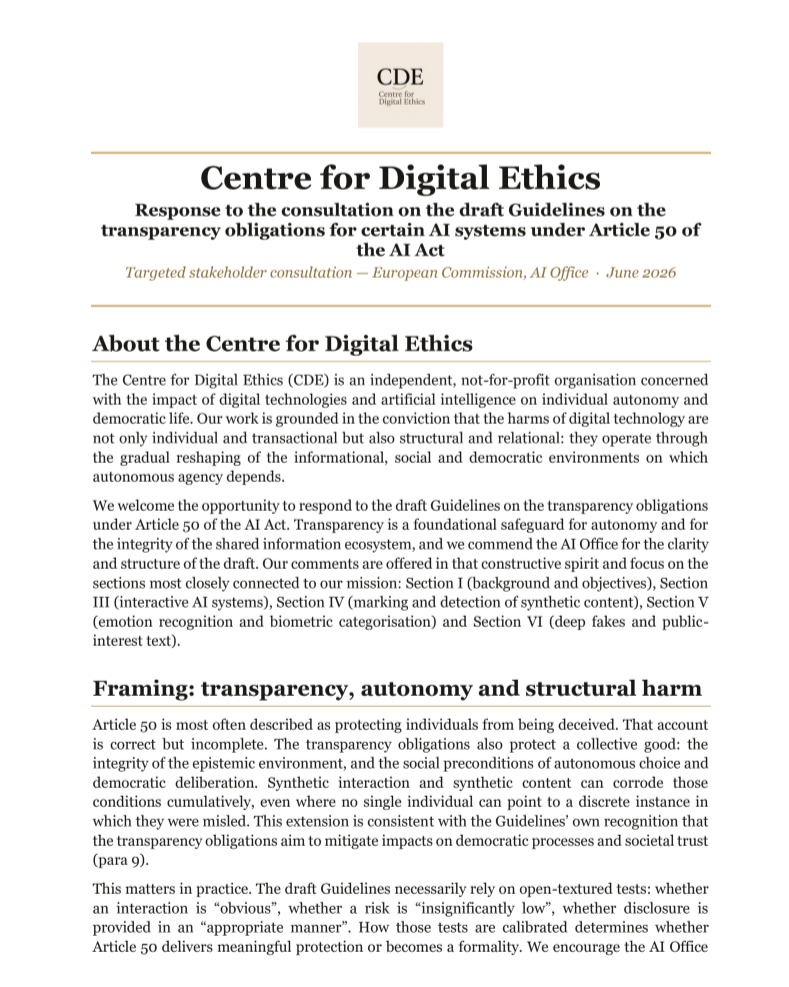
CDE Response on the draft Article 50 Transparency Guidelines

Response to the consultation on the draft Guidelines on the transparency obligations for certain AI systems under Article 50 of the AI Act

This document is the CDE’s response to the European Commission’s consultation on draft Article 50 AI Act transparency guidelines. The CDE welcomes the proposed rules but argues that transparency obligations should be interpreted more broadly to protect not only individuals from deception but also the wider information ecosystem, democratic processes, and public trust. The submission recommends stronger disclosure requirements for AI systems, more robust safeguards for synthetic content and deepfakes, clearer rules for emotion recognition and biometric categorisation, and an overall approach that treats transparency as a minimum safeguard rather than a justification for potentially harmful AI practices.

Read the full submission

Monthly Newsletter sent directly to subscribers inboxes

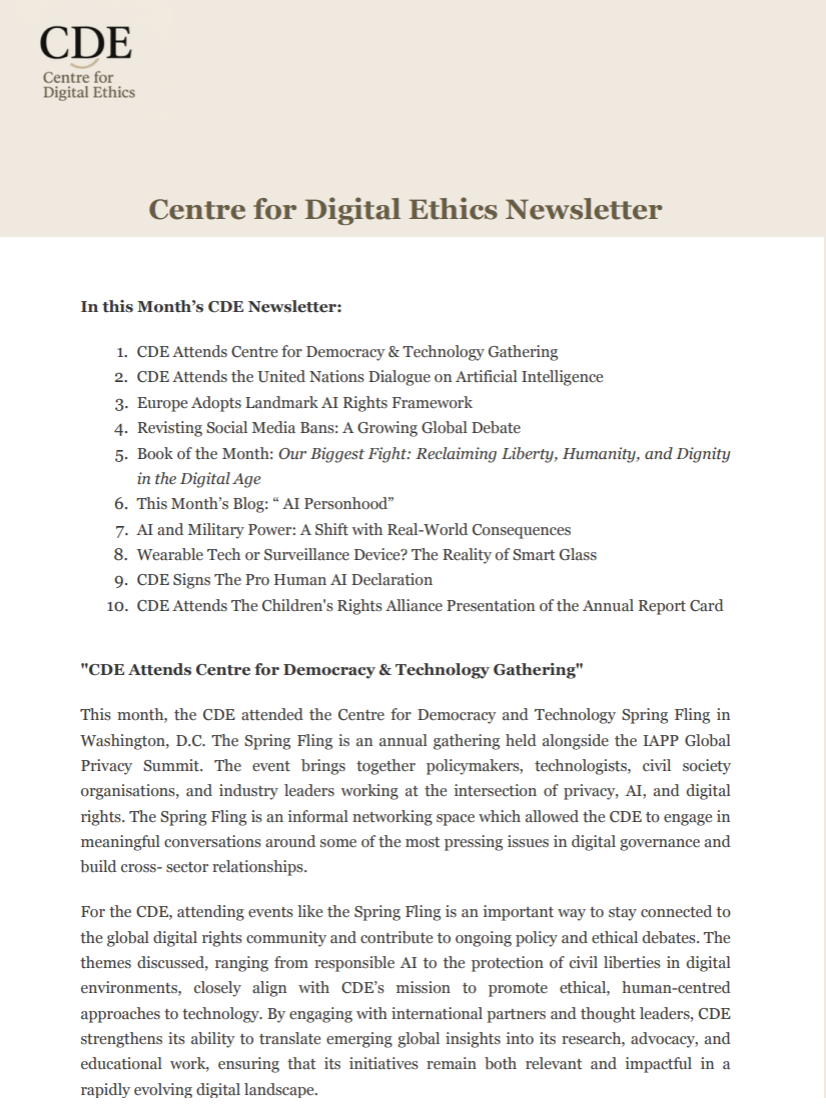
CDE February Newsletter

This edition of the CDE newsletter explores key global developments in AI governance, digital rights, and emerging technologies. It highlights international policy discussions, including UN and EU initiatives, alongside debates on social media regulation, AI in military contexts, and the ethical implications of new technologies such as wearable devices. The newsletter also features thought pieces on AI personhood, digital autonomy, and the broader societal impact of AI, alongside updates on the CDE’s ongoing work and engagements.

Read the full newsletter →

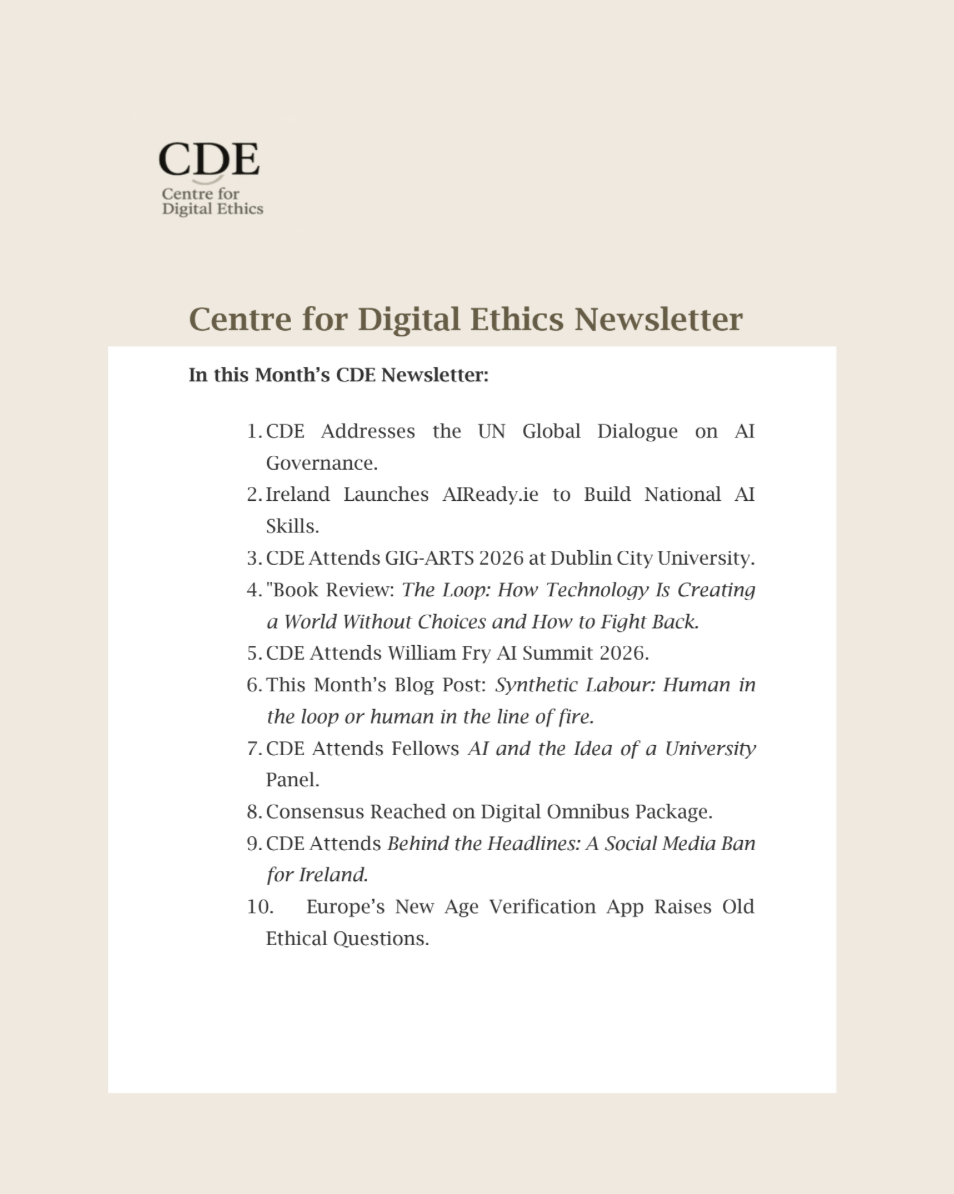
CDE April Newsletter

 Monthly Newsletter sent directly to subscribers inboxes  

This newsletter highlights the CDE’s activities and commentary during April–May 2026, covering developments in AI governance, digital rights, online safety, and technology regulation. It reports on the CDE’s participation in international and Irish policy discussions, including the UN Global Dialogue on AI Governance, examines emerging issues such as synthetic labour, age verification, and social media regulation, and reviews recent developments in EU AI policy. Across its articles, the newsletter emphasises human autonomy, democratic accountability, digital rights, and the need for AI governance frameworks that address not only individual harms but also broader societal and structural impacts.

Read the full newsletter